Erin Bushnell
Point BlankErin Bushnell is a gifted violinist from Sioux City, Iowa, whose murder turns a cave discovery into the center of a widening investigation. A fourth-year student at Stanislaus School of Music, she is remembered for her extraordinary musicianship and promise; the circumstances of her death, however, were manipulated to mislead investigators about who had killed her and why.
Identity and Musical Promise
At twenty-two, Erin was nearing the end of her undergraduate music studies. She was due to receive a bachelor of music degree in May and, according to her teacher, was considering staying at Stanislaus School of Music to pursue a master’s degree. Her future had a clear shape, even if her plans beyond further study were not settled: she was a young musician whose ability had already made a deep impression on people around her.
Gordon Holcombe, the director of Stanislaus School of Music, described her as exceptionally talented and said he had been working with her on control and spontaneity. That pairing mattered to his understanding of artistry: technical practice, he believed, should allow a performance to feel newly and freely made. He singled out Erin’s playing of Bartók’s Sonata for Solo Violin as brilliant, and later recalled her interpretation of Brahms’s violin sonatas for Joseph Joachim as transcendent. His praise presents her not simply as a promising student, but as an artist whose performances could move listeners profoundly.
Education and Relationships
Erin’s relationship with Gordon was not only that of student and director. He said that she came to his house on Halloween dressed as Titania from A Midsummer Night’s Dream, and that later that night she called him her Oberon. He acknowledged becoming involved with her and described her company as a source of pleasure, while distinguishing his feelings for Erin from those he had for Helen Rafferty. The account establishes a relationship with a substantial imbalance of institutional position, though the evidence here does not explain how Erin understood it or what she wanted from it.
Gordon’s recollection of Erin as artist and companion sits uneasily beside his initial reaction to news of her death. When Dixon Noble told him she had been found murdered in a chamber in Winkel’s Cave, Gordon struggled to accept that the victim was Erin, repeatedly questioning whether the identification could be right. He focused on her youth, talent, and promise. The news reached him not as an abstract campus tragedy but as the loss of a student he had known closely, and his grief would later be complicated by the investigation’s suspicion of him.
Murder and the Investigation
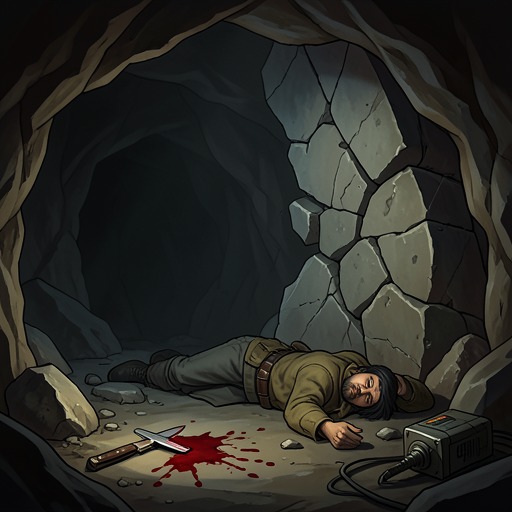
Erin’s body was discovered in a concealed chamber in Winkel’s Cave after Ruth Warnecki entered it. Investigators believed Erin had been killed shortly before Ruth arrived and that the murderer had brought her into the chamber and covered the exits, apparently intending to keep her from being found. At three o’clock that afternoon, her body was placed in a medical examiner’s van and taken to the morgue in the basement of the Loudoun County hospital. The transfer marked the beginning of the forensic inquiry, while the concealment of the body made the cave itself part of the mystery.
The investigation eventually established that Helen had hired two men to kill Erin, rather than to attack Ruth, as Dixon first clarified to Gordon. Tommy Dempsey and Jackie Slater disabled Erin with a hallucinogenic drug, killed her, and then embalmed and posed her. Dempsey’s stepfather had worked in a funeral home, where Dempsey had apparently observed the process. The staging made the murder resemble a ritual killing rather than a contract killing; it was intended as a misdirection in case the body was discovered too soon.
That disguise had consequences for the investigation. The apparent ritual treatment led investigators to consider whether Erin was one victim in a series and to spend time searching for other victims, including women who had been students and lovers of Gordon. Their absence complicated the theory that Gordon was a serial killer, but did not immediately remove him from suspicion. The staged appearance of Erin’s body thus shaped not only what investigators thought had happened to her, but also whom they suspected and what avenues they pursued.
Memorial and Narrative Significance
Erin’s memorial filled the large auditorium in Gainsborough Hall. A dozen wreaths surrounded the stage, and a large color photograph showed her playing the violin. Students and professors filled the available seats; others stood along the walls or sat on the aisle steps, while people from the town were also present. Her parents, described as pale and silent, attended after Dixon had already offered his condolences. The gathering made visible the breadth of the loss: Erin’s death had reached beyond the people immediately involved in the investigation.
Dixon knew that the details of what had been done to Erin would deepen her parents’ grief, and hoped those who knew the full truth would keep it from them. The memorial therefore holds two versions of her story in tension: the public remembrance of a young musician whose work and future mattered to a crowded community, and the concealed facts of a murder deliberately arranged to distort its meaning. Erin’s artistic identity remains distinct from the crime that ends her life, even as the investigation must reconstruct that crime to recover the truth.